







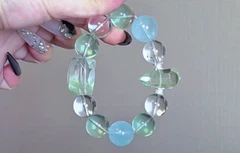

Are natural crystal balls magnetic? This is a question that often pops up among crystal enthusiasts and potential buyers. As a supplier of Natural Crystal Ball, I've encountered this query numerous times. In this blog post, I'll delve into the science behind natural crystal balls and their magnetic properties, providing you with a comprehensive understanding of this fascinating topic.
Understanding Natural Crystals
Before we discuss the magnetic properties of natural crystal balls, it's crucial to understand what natural crystals are. Natural crystals are formed through a process of crystallization, where atoms or molecules arrange themselves in a highly ordered, repeating pattern. This process occurs deep within the Earth's crust over millions of years, under specific conditions of temperature and pressure.
There are various types of natural crystals, each with its unique chemical composition and physical properties. Some of the most common crystals used to make crystal balls include quartz, amethyst, citrine, and obsidian. These crystals are prized for their beauty, clarity, and alleged metaphysical properties.
The Science of Magnetism
Magnetism is a fundamental force of nature that arises from the motion of electric charges. In simple terms, a magnetic field is created when electric charges move in a coordinated way. Materials can be classified into three main categories based on their magnetic properties: ferromagnetic, paramagnetic, and diamagnetic.
- Ferromagnetic materials are strongly attracted to magnetic fields and can retain their magnetization even after the external magnetic field is removed. Examples of ferromagnetic materials include iron, nickel, and cobalt.
- Paramagnetic materials are weakly attracted to magnetic fields. Their magnetization is temporary and only exists in the presence of an external magnetic field. Examples of paramagnetic materials include aluminum, oxygen, and platinum.
- Diamagnetic materials are repelled by magnetic fields. They have a very weak magnetic response and are not attracted to magnets. Examples of diamagnetic materials include copper, silver, and gold.
Are Natural Crystal Balls Magnetic?
The magnetic properties of natural crystal balls depend on their chemical composition. Most natural crystals, such as quartz, amethyst, and citrine, are diamagnetic. This means that they are repelled by magnetic fields and do not exhibit any significant magnetic properties.
Quartz, for example, is a silicon dioxide mineral with a very stable chemical structure. It does not contain any ferromagnetic or paramagnetic elements, so it is not attracted to magnets. Amethyst and citrine are both varieties of quartz, so they also share the same diamagnetic properties.
However, there are some exceptions. Some natural crystals may contain trace amounts of ferromagnetic or paramagnetic elements, which can give them weak magnetic properties. For example, hematite is a mineral that contains iron, which is a ferromagnetic element. Hematite crystal balls may exhibit some magnetic attraction due to the presence of iron.


Another example is lodestone, which is a naturally magnetized form of magnetite. Magnetite is a ferromagnetic mineral, so lodestone is strongly attracted to magnetic fields. Lodestone crystal balls are rare and highly prized for their unique magnetic properties.
Testing the Magnetic Properties of Natural Crystal Balls
If you're curious about the magnetic properties of a natural crystal ball, you can perform a simple test using a magnet. Here's how:
- Obtain a small, strong magnet. A neodymium magnet is ideal for this test.
- Hold the magnet close to the crystal ball without touching it.
- Observe the reaction of the crystal ball. If the crystal ball is attracted to the magnet, it may contain ferromagnetic or paramagnetic elements. If the crystal ball is repelled by the magnet, it is likely diamagnetic.
It's important to note that this test is not conclusive, as the presence of trace amounts of magnetic elements may not be detectable using a simple magnet. If you want a more accurate analysis of the magnetic properties of a crystal ball, you may need to consult a professional geologist or mineralogist.
The Importance of Magnetic Properties in Natural Crystal Balls
The magnetic properties of natural crystal balls are not typically a major consideration for most buyers. The primary reasons people purchase crystal balls are for their beauty, clarity, and alleged metaphysical properties. However, for some applications, such as scientific research or industrial use, the magnetic properties of a crystal ball may be important.
For example, in the field of geology, magnetic properties can provide valuable information about the composition and structure of rocks and minerals. By studying the magnetic properties of crystal balls, geologists can gain insights into the geological processes that formed them.
In the industrial sector, crystal balls with specific magnetic properties may be used in applications such as magnetic resonance imaging (MRI), magnetic sensors, and magnetic storage devices.
Conclusion
In conclusion, most natural crystal balls are not magnetic. They are typically diamagnetic, which means that they are repelled by magnetic fields. However, some natural crystals may contain trace amounts of ferromagnetic or paramagnetic elements, which can give them weak magnetic properties.
If you're interested in purchasing a natural crystal ball, the magnetic properties are not usually a significant factor to consider. Instead, focus on the beauty, clarity, and quality of the crystal ball. At our company, we offer a wide range of Natural Crystal Ball in various sizes, shapes, and colors. We also offer Natural Crystal Pendant and Natural Crystal Crushed Stone for those who want to incorporate natural crystals into their jewelry or crafts.
If you have any questions or would like to discuss purchasing options, please feel free to contact us. We're here to help you find the perfect natural crystal products for your needs.
References
- Kittel, C. (1996). Introduction to Solid State Physics. Wiley.
- Nesse, W. D. (2000). Introduction to Mineralogy. Oxford University Press.
- Skinner, B. J., & Porter, S. C. (1995). The Dynamic Earth: An Introduction to Physical Geology. Wiley.


