







Crystal pillars, with their captivating beauty and mysterious allure, have long fascinated humanity. As a dedicated supplier of crystal pillars, I've had the privilege of exploring these remarkable formations up close. In this blog, I'll delve into the scientific processes behind the creation of crystal pillars, shedding light on their unique journey from the earth's depths to your hands.
The Basics of Crystal Formation
To understand how crystal pillars are formed, we first need to grasp the fundamental principles of crystal growth. Crystals are solid materials whose atoms, molecules, or ions are arranged in a highly ordered, repeating pattern extending in all three spatial dimensions. This ordered structure gives crystals their characteristic geometric shapes and properties.
The formation of crystals begins with a process called nucleation. Nucleation occurs when a small cluster of atoms or molecules comes together to form a stable nucleus. This nucleus then serves as a seed for further crystal growth. There are two main types of nucleation: homogeneous and heterogeneous.
Homogeneous nucleation happens when the atoms or molecules in a supersaturated solution or a supercooled liquid spontaneously come together to form a nucleus. This process requires specific conditions, such as a high degree of supersaturation or supercooling, and is relatively rare in nature.
Heterogeneous nucleation, on the other hand, occurs when the atoms or molecules in a solution or a liquid attach themselves to a foreign particle, such as a dust grain or a small crystal fragment. This foreign particle provides a surface for the atoms or molecules to adhere to, making it easier for the nucleus to form. Heterogeneous nucleation is much more common in nature and plays a crucial role in the formation of crystal pillars.
The Role of Minerals and Solutions
Crystal pillars are typically made up of minerals, which are naturally occurring inorganic substances with a specific chemical composition and a characteristic crystal structure. Different minerals have different chemical compositions and physical properties, which determine the shape, color, and other characteristics of the crystal pillars they form.
One of the most common minerals found in crystal pillars is quartz. Quartz is a silicon dioxide mineral that comes in a variety of colors, including clear, white, pink, purple, and smoky. Quartz crystal pillars are known for their clarity, hardness, and durability, making them a popular choice for decorative and metaphysical purposes.
Another important mineral in crystal pillar formation is calcite. Calcite is a calcium carbonate mineral that is often found in sedimentary rocks. Calcite crystal pillars can have a wide range of colors and shapes, depending on the impurities present in the mineral. They are prized for their beautiful iridescence and their ability to refract light.
The formation of crystal pillars also requires a suitable solution. A solution is a homogeneous mixture of two or more substances, where one substance (the solute) is dissolved in another substance (the solvent). In the case of crystal pillar formation, the solute is the mineral that will form the crystal, and the solvent is usually water.
The concentration of the solute in the solution is an important factor in crystal growth. A supersaturated solution, which contains more solute than can normally be dissolved in the solvent at a given temperature and pressure, is required for crystal formation to occur. When a supersaturated solution is cooled or when the solvent evaporates, the excess solute will begin to crystallize out of the solution, forming a nucleus.
The Influence of Temperature and Pressure
Temperature and pressure play a crucial role in the formation of crystal pillars. As the temperature and pressure conditions change, the solubility of the minerals in the solution also changes, which can affect the rate and direction of crystal growth.
In general, higher temperatures increase the solubility of minerals in water, while lower temperatures decrease solubility. This means that when a supersaturated solution is cooled, the excess solute will begin to crystallize out of the solution more rapidly. The rate of crystal growth is also affected by the temperature gradient, which is the difference in temperature between the solution and the surrounding environment. A steeper temperature gradient can lead to faster crystal growth.
Pressure also has an impact on crystal formation. In the earth's crust, pressure increases with depth. Higher pressures can cause the atoms and molecules in a mineral to pack more closely together, which can affect the crystal structure and the shape of the crystal pillars. For example, some minerals may form different crystal structures under high pressure conditions compared to low pressure conditions.


The Growth of Crystal Pillars
Once a nucleus has formed, the crystal begins to grow by the addition of atoms or molecules to the surface of the nucleus. This process is called crystal growth. The rate and direction of crystal growth are determined by several factors, including the temperature, pressure, the concentration of the solute in the solution, and the presence of impurities.
Crystal growth can occur in different directions, depending on the crystal structure of the mineral. Some minerals, such as quartz, have a hexagonal crystal structure, which means that they tend to grow in a six-sided prism shape. Other minerals, such as calcite, have a rhombohedral crystal structure, which can result in a variety of shapes, including rhombohedrons, scalenohedrons, and prisms.
As the crystal grows, it may encounter obstacles or impurities in the solution. These obstacles and impurities can cause the crystal to grow in an irregular or distorted shape. However, in some cases, these irregularities can add to the beauty and uniqueness of the crystal pillar.
Natural and Synthetic Crystal Pillars
Crystal pillars can be formed naturally or synthetically. Natural crystal pillars are formed over long periods of time in the earth's crust, under the influence of natural geological processes. These processes can take thousands or even millions of years, and the resulting crystal pillars are often one-of-a-kind, with unique shapes, colors, and inclusions.
Synthetic crystal pillars, on the other hand, are created in a laboratory setting using artificial methods. Synthetic crystal growth involves carefully controlling the temperature, pressure, and chemical composition of a solution to mimic the natural conditions under which crystals form. Synthetic crystal pillars can be produced more quickly and in larger quantities than natural crystal pillars, and they can be designed to have specific properties and characteristics.
As a supplier of crystal pillars, I offer both natural and synthetic options to meet the diverse needs of my customers. Natural crystal pillars are highly prized for their authenticity and their connection to the earth's natural energy. They are often used in spiritual and healing practices, as well as for decorative purposes. Synthetic crystal pillars, on the other hand, are a more affordable and accessible option, and they can be a great choice for those who are looking for a specific color or shape.
Our Crystal Pillar Offerings
At our company, we take pride in offering a wide range of high-quality crystal pillars to our customers. Whether you're looking for a beautiful decorative piece for your home or office, or you're interested in the metaphysical properties of crystals, we have the perfect crystal pillar for you.
Our Home Crystal Column collection features a variety of natural and synthetic crystal pillars that are designed to enhance the energy and beauty of your living space. These crystal pillars come in different sizes, shapes, and colors, and they can be used to create a focal point in any room.
If you're interested in the energy properties of crystals, our Energy Crystal Column collection is the perfect choice for you. These crystal pillars are carefully selected for their unique energy vibrations and their ability to promote balance, harmony, and well-being. They can be used in meditation, healing, and other spiritual practices.
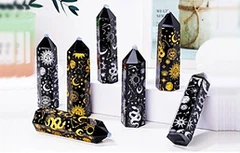
For those who are looking for something truly unique, our Obsidian Crystal Tower collection offers a range of stunning obsidian crystal pillars. Obsidian is a volcanic glass that is known for its powerful protective properties and its ability to absorb negative energy. These obsidian crystal towers are a great addition to any crystal collection.
Contact Us for Purchase and Inquiry
If you're interested in purchasing our crystal pillars or have any questions about our products, please don't hesitate to contact us. We're always happy to help you find the perfect crystal pillar for your needs. Whether you're a collector, a healer, or simply someone who appreciates the beauty of crystals, we look forward to serving you.
References
- Deer, W. A., Howie, R. A., & Zussman, J. (1992). An introduction to the rock-forming minerals. Longman Scientific & Technical.
- Gaines, R. V., Skinner, B. J., Foord, E. E., Mason, C. B., & Rosenzweig, A. (1997). Dana's new mineralogy: The system of mineralogy of James Dwight Dana and Edward Salisbury Dana. Wiley.
- Putnis, A. (1992). Introduction to mineral sciences. Cambridge University Press.


