



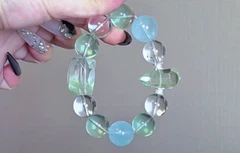

Hey there! As a supplier of crystal carvings, I've always been fascinated by how these beautiful pieces interact with light. It's like a magical dance that brings out the best in each carving, creating a visual spectacle that's truly one-of-a-kind. In this blog, I'll take you through the science behind this interaction and show you why crystal carvings are so special.
Let's start with the basics. Crystals are made up of atoms arranged in a regular, repeating pattern. This structure gives them unique optical properties that allow them to interact with light in different ways. When light hits a crystal, it can be reflected, refracted, or absorbed. Each of these interactions plays a crucial role in creating the stunning visual effects we see in crystal carvings.
Reflection is the process by which light bounces off the surface of a crystal. The smooth, polished surfaces of crystal carvings are excellent reflectors, which means they can bounce light back in different directions. This creates a sparkling effect that catches the eye and adds a touch of glamour to any space. The angle at which the light hits the crystal also affects the reflection. When light hits a crystal at a shallow angle, it reflects off the surface at a similar angle, creating a bright, intense sparkle. On the other hand, when light hits a crystal at a steep angle, it reflects off the surface at a wider angle, creating a softer, more diffused sparkle.


Refraction is another important optical property of crystals. When light passes through a crystal, it bends or changes direction. This is because the speed of light changes as it moves from one medium (such as air) to another (such as crystal). The amount of refraction depends on the angle at which the light enters the crystal and the refractive index of the crystal. The refractive index is a measure of how much the speed of light is reduced when it passes through a material. Crystals have a high refractive index, which means they bend light more than other materials. This creates a beautiful rainbow effect called dispersion, where the different colors of light are separated and spread out.
Absorption is the process by which light is absorbed by a crystal. Some crystals, such as amethyst and citrine, have unique chemical properties that allow them to absorb certain wavelengths of light. This gives them their characteristic color. For example, amethyst is purple because it absorbs yellow and green light, while citrine is yellow because it absorbs blue and violet light. The amount of absorption depends on the thickness and quality of the crystal, as well as the intensity and wavelength of the light.
Now that we understand the basic principles of how crystals interact with light, let's take a closer look at how these interactions are used to create stunning crystal carvings. One of the most common techniques used in crystal carving is faceting. Faceting involves cutting and polishing the surface of a crystal to create flat, smooth surfaces called facets. These facets are arranged in a specific pattern to maximize the reflection and refraction of light. When light hits a faceted crystal, it bounces off the facets at different angles, creating a dazzling display of light and color.
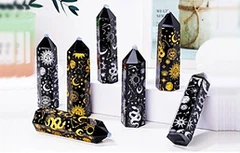
Another technique used in crystal carving is engraving. Engraving involves cutting or etching designs into the surface of a crystal. This can be done using a variety of tools, such as lasers, diamond-tipped cutters, or sandblasting. Engraving can be used to create intricate patterns, images, or text on the surface of a crystal. When light hits an engraved crystal, it reflects off the raised areas and is absorbed by the recessed areas, creating a contrast between light and dark. This adds depth and dimension to the carving and makes it more visually interesting.
In addition to faceting and engraving, crystal carvers also use a variety of other techniques to enhance the interaction between light and crystal. For example, they may use different shapes and sizes of crystals to create different effects. A large, round crystal may create a soft, diffused sparkle, while a small, pointed crystal may create a bright, intense sparkle. They may also use different colors of crystals to create a contrast or a complementary color scheme. For example, a pink crystal carving may be paired with a white or clear crystal to create a romantic, feminine look, while a green crystal carving may be paired with a yellow or orange crystal to create a vibrant, energetic look.
At our company, we offer a wide range of crystal carvings in different shapes, sizes, and colors. Whether you're looking for a simple, elegant piece or a more elaborate, decorative piece, we have something to suit your taste and budget. Some of our most popular products include Pink Crystal Carvings, Christmas Crystal Carvings, and Citrine Carvings. Each of these products is carefully crafted by our skilled artisans to ensure the highest quality and attention to detail.
If you're interested in purchasing crystal carvings for your home, office, or as a gift, we'd love to hear from you. We offer competitive prices, fast shipping, and excellent customer service. Whether you have a specific design in mind or need some inspiration, our team of experts is here to help you find the perfect crystal carving for your needs. So why wait? Contact us today to start your journey into the world of crystal carvings!
References
- "Optics of Crystals." Encyclopedia Britannica.
- "The Science of Crystals." American Museum of Natural History.
- "Crystal Carving Techniques." Gemstone Artisans Association.


