

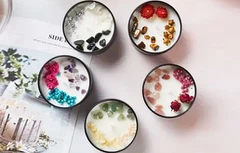



In the realm of home decor and holistic well - being, crystal scented candles have gained significant popularity. As a supplier of these enchanting products, I often encounter customers who are curious about the authenticity of the crystals embedded in the candles. It's a valid concern, as the value and purported benefits of these candles are often tied to the realness of the crystals. In this blog, I'll share some insights on how to determine if the crystals in a candle are real.
Understanding the Appeal of Crystal Scented Candles
Crystal scented candles are not just ordinary candles. They combine the soothing ambiance of a scented candle with the supposed energetic properties of crystals. For instance, amethyst is believed to promote calmness and spiritual awareness, while rose quartz is associated with love and compassion. These candles are often used for meditation, relaxation, and creating a positive atmosphere in the home. They have become a staple in many households, and their demand has led to a proliferation of products in the market, both genuine and otherwise.
When it comes to the market, there are various types of crystal scented candles available. You can explore Healing Crystal Candles which are specifically designed to harness the healing energies of crystals. Amethyst Crystal Candles are another popular choice, known for their beautiful purple hue and calming properties. And if you're looking for candles that are said to boost energy, Crystal Energy Candles might be the perfect fit.
Visual Inspection
One of the first steps in determining the authenticity of the crystals in a candle is a visual inspection. Real crystals have unique characteristics that can be observed with the naked eye.


Color and Clarity
Natural crystals often have variations in color and clarity. For example, amethyst can range from a pale lilac to a deep purple, and it may have inclusions or slight color variations within the crystal. These inclusions are actually a sign of authenticity, as they are caused by impurities that were trapped during the crystal's formation. In contrast, fake crystals may have a uniform color that looks too perfect, without any natural variations.
Shape and Texture
Real crystals have distinct shapes based on their crystal structure. Quartz crystals, for instance, typically have a hexagonal shape with pointed ends. The surface of a real crystal may also have small imperfections, such as tiny scratches or rough edges. Fake crystals, on the other hand, may be more uniform in shape and have a smooth, plastic - like texture.
Hardness Test
The Mohs scale of mineral hardness can be a useful tool in determining the authenticity of a crystal. This scale ranks minerals from 1 (softest) to 10 (hardest). For example, talc has a hardness of 1, while diamond has a hardness of 10.
If you suspect that the crystal in your candle is quartz (which has a hardness of 7 on the Mohs scale), you can try a simple hardness test. Find a common object with a known hardness. A copper penny has a hardness of about 3.5. If the crystal can scratch the penny, it is likely to be a harder mineral like quartz. However, this test should be done with caution, as you don't want to damage the candle or the crystal.
Density and Weight
Real crystals have a specific density that is characteristic of their mineral composition. If you have two candles with what are supposed to be the same type of crystal, but one feels significantly lighter or heavier than the other, it could be a sign that one of the crystals is fake.
You can also compare the weight of the crystal in the candle to the weight of a known real crystal of the same type and size. This may require some research to find out the average density of the specific crystal you're dealing with.
Chemical and Thermal Tests
These tests are more advanced and should be done with extreme caution, as they may damage the candle or the crystal. Chemical tests involve using certain chemicals to react with the crystal to determine its composition. However, this is not recommended for the average consumer, as it can be dangerous and may void the warranty of the candle.
Thermal tests involve subjecting the crystal to heat. Real crystals have a specific melting point and will react differently to heat compared to fake crystals. But again, this test should only be performed by professionals, as heating a candle can be a fire hazard.
Supplier Reputation
One of the most reliable ways to ensure that the crystals in your candle are real is to buy from a reputable supplier. As a crystal scented candle supplier, I take pride in sourcing high - quality, authentic crystals for my products. I work with trusted miners and wholesalers who can provide certificates of authenticity for the crystals.
When you're looking to purchase a crystal scented candle, do some research on the supplier. Check online reviews, ask for recommendations from friends or family, and see if the supplier provides any information about the origin and authenticity of the crystals. A reputable supplier will be transparent about their sourcing and manufacturing processes.
Price Consideration
While price is not always an indicator of authenticity, extremely low - priced crystal scented candles may be a red flag. Authentic crystals can be expensive, especially if they are of high quality. If a candle is priced significantly lower than others on the market, it's possible that the crystals are fake or of poor quality.
However, it's also important to note that just because a candle is expensive doesn't necessarily mean the crystals are real. Some unscrupulous sellers may overcharge for fake products. So, price should be considered in conjunction with other factors such as visual inspection, supplier reputation, etc.
Conclusion
Determining the authenticity of the crystals in a candle requires a combination of visual inspection, basic tests, and research on the supplier. As a crystal scented candle supplier, I understand the importance of providing customers with genuine products. The crystals in my candles are carefully selected and tested to ensure their authenticity.
If you're interested in purchasing high - quality crystal scented candles with real crystals, I invite you to reach out for a procurement discussion. Whether you're looking for Healing Crystal Candles, Amethyst Crystal Candles, or Crystal Energy Candles, I can offer you a wide range of options to suit your needs.
References
- "The Crystal Bible" by Judy Hall
- "Gemstones of the World" by Walter Schumann
- Online resources on crystal identification and candle - making


