



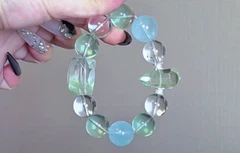

Tea crystal, also known as smoky quartz, is a captivating variety of quartz that has long been cherished for its unique color and metaphysical properties. As a supplier of tea crystal bracelets, I often receive inquiries about the density of tea crystal. In this blog post, I'll delve into the details of tea crystal density, how it's measured, and why it matters in the context of our beautiful tea crystal bracelets.
Understanding Tea Crystal
Tea crystal is a type of quartz that gets its characteristic smoky to brownish color from natural radiation and trace amounts of aluminum within the crystal structure. It forms deep within the Earth's crust under high pressure and temperature conditions. Quartz, in general, is one of the most abundant minerals on Earth, and tea crystal is a popular choice for jewelry due to its attractive appearance and perceived healing properties.
Density of Tea Crystal
The density of a mineral is defined as its mass per unit volume. For tea crystal, the density typically ranges from 2.65 to 2.66 grams per cubic centimeter (g/cm³). This value is consistent with the density of quartz in general because tea crystal is a variety of quartz. The density of a mineral is an important physical property that can help in its identification and quality assessment.
Measuring the Density of Tea Crystal
There are several methods to measure the density of a mineral, but one of the most common and straightforward ways is the water displacement method. Here's a step-by-step guide on how to measure the density of a tea crystal bead from one of our bracelets:
- Weigh the Crystal: Use a precise digital scale to measure the mass of the tea crystal bead. Record this value in grams.
- Measure the Volume: Fill a graduated cylinder partially with water and record the initial volume of the water. Carefully place the tea crystal bead into the cylinder, making sure no water spills out. Record the new volume of the water with the bead submerged. The difference between the two volumes is the volume of the tea crystal bead, measured in cubic centimeters.
- Calculate the Density: Divide the mass of the tea crystal bead by its volume. The result is the density of the tea crystal in grams per cubic centimeter.
Why Density Matters in Tea Crystal Bracelets
The density of tea crystal can have several implications for our tea crystal bracelets:
- Quality Assurance: A consistent density within the expected range for tea crystal indicates a high - quality, pure specimen. Deviations from the typical density range may suggest impurities or a different mineral altogether.
- Authenticity: Density measurement can be used as a tool to verify the authenticity of tea crystal. If a supposed tea crystal bracelet has a density significantly different from the known range for tea crystal, it may not be genuine.
- Aesthetic and Durability: Higher - quality tea crystals with proper density tend to have better clarity, color, and durability. This means that our tea crystal bracelets will not only look more beautiful but also last longer.
Comparing Tea Crystal with Other Crystals in Our Bracelet Collection
In our collection, we also offer other types of crystal bracelets, such as the Green Fluorite Crystal Bracelet, Black Gold Crystal Bracelet, and Kunzite Crystal Bracelet. Each of these crystals has its own unique density:
- Green Fluorite: The density of green fluorite typically ranges from 3.18 to 3.22 g/cm³. This is higher than tea crystal, which is due to its different chemical composition. Fluorite is a calcium fluoride mineral, while tea crystal is silicon dioxide.
- Black Gold Crystal: The density of black gold crystal can vary depending on its specific composition, but it generally falls around 3.5 - 4.0 g/cm³. This relatively high density is often associated with its metallic inclusions and unique crystal structure.
- Kunzite: Kunzite has a density of about 3.03 - 3.10 g/cm³. It is a lithium aluminum silicate mineral, and its density reflects its chemical makeup.
The Role of Density in the Design and Manufacturing of Tea Crystal Bracelets
When designing and manufacturing our tea crystal bracelets, we take the density of tea crystal into account in several ways:
- Bead Size and Weight: Knowing the density helps us determine the appropriate size and weight of the tea crystal beads for a comfortable and aesthetically pleasing bracelet. We can ensure that the bracelets are not too heavy or too light.
- Mixing with Other Materials: If we choose to combine tea crystal beads with other materials in a bracelet, understanding the density of tea crystal allows us to balance the overall weight and feel of the bracelet.
- Quality Control: During the manufacturing process, we can use density measurements as part of our quality control checks to ensure that only the highest - quality tea crystal beads are used in our bracelets.
Metaphysical and Cultural Significance of Tea Crystal Density
Beyond the scientific aspects, tea crystal also holds significant metaphysical and cultural value. In many cultures, the density of a crystal is associated with its energy - holding capacity. A higher - density tea crystal is believed to have a stronger and more stable energy field.
- Grounding and Protection: Tea crystal is often used for grounding and protection. It is thought that the dense structure of the crystal can help absorb negative energy and provide a sense of stability and security.
- Healing Properties: Some people believe that the density of tea crystal is related to its healing properties. It is said to have a calming effect on the mind and body, and its dense energy can help in the process of emotional and physical healing.
Conclusion
In conclusion, the density of tea crystal is an important physical property that plays a crucial role in the identification, quality assessment, and design of our tea crystal bracelets. With a typical density range of 2.65 - 2.66 g/cm³, tea crystal stands out as a unique and beautiful variety of quartz. Whether you're interested in the scientific aspects of tea crystal or its metaphysical properties, our tea crystal bracelets offer a combination of beauty and value.


If you're interested in purchasing our tea crystal bracelets or have any questions about our products, we invite you to contact us for a procurement discussion. We're always happy to share our knowledge and expertise in the world of crystal bracelets.
References
- Deer, W. A., Howie, R. A., & Zussman, J. (1992). An Introduction to the Rock - Forming Minerals. Longman Scientific & Technical.
- Gaines, R. V., Skinner, B. J., Foord, E. E., Mason, B., & Rosenzweig, A. (1997). Dana's New Mineralogy: The System of Mineralogy of James Dwight Dana and Edward Salisbury Dana. Wiley - Interscience.
- Nesse, W. D. (2000). Introduction to Mineralogy. Oxford University Press.


